Fleet Operators Are Moving on 2027 Emissions Rules Now
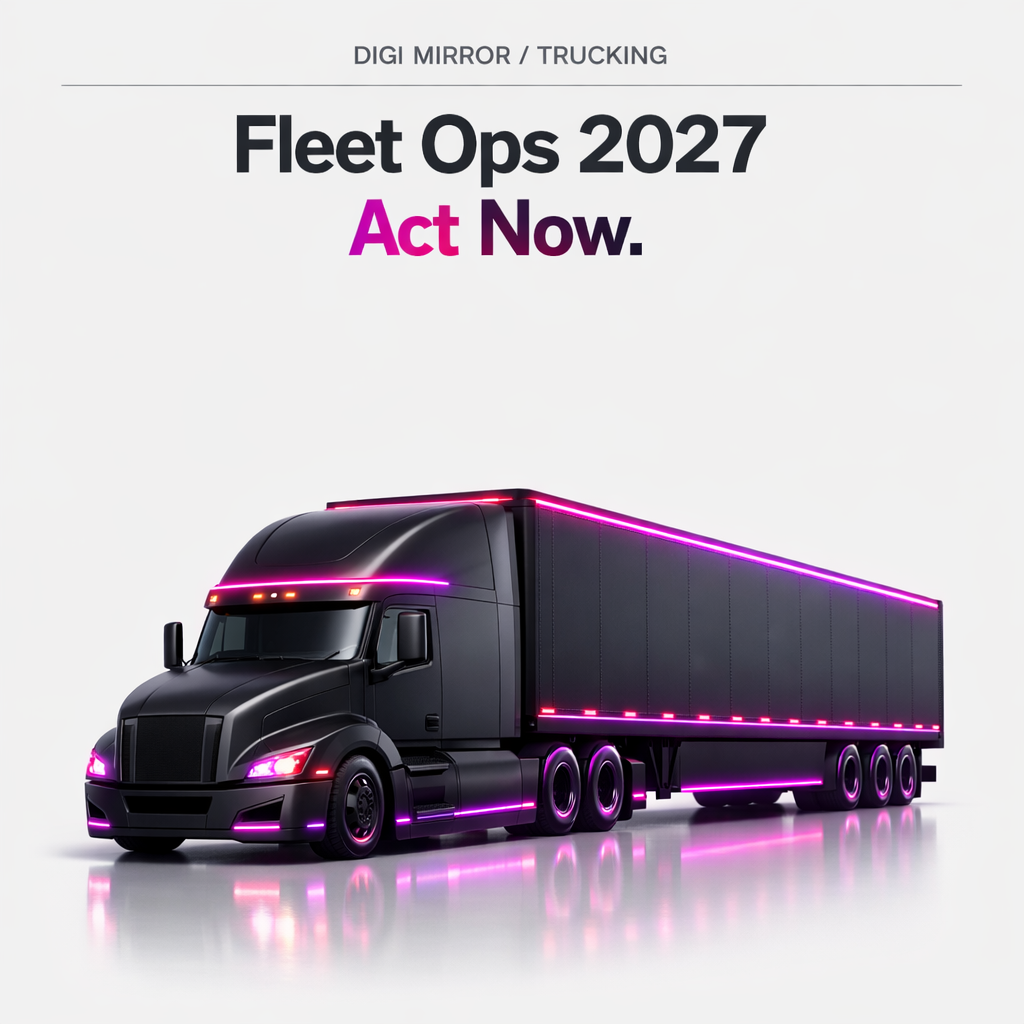
TL;DR: Fleet operators who waited out years of regulatory back-and-forth on emissions and autonomous tech now have enough clarity to act — and the ones sitting still are falling behind on capital planning, technician pipeline, and AI adoption. Transport Topics’ RoadSigns podcast series maps the exact decisions fleet leaders must lock in before 2027 arrives.
Regulatory Whiplash Is Over — The Clock Is Running
Brian Antonellis, SVP of fleet operations at Fleet Advantage, put it plainly in Episode 194: after years of uncertainty, fleets now know what the next 12 months look like. The 2027 NOx emissions rules are real, the timeline is fixed, and operators who haven’t started capital planning are already late. That clarity is actually good news — but only if you use it.
The specific question every fleet CFO needs to answer right now: do you pre-buy compliant 2026 equipment, or do you hold capital and wait for incoming technology? Antonellis doesn’t frame this as a philosophical debate. It’s a math problem. Pre-buy opportunities carry known cost-per-mile inputs; incoming tech carries infrastructure and technician unknowns. Most fleets running 50-plus units have enough operational data to run the numbers — the operators who aren’t running them are the ones who’ll get caught flat-footed when the rules hit.
Episode 185 added context: freight rates are still depressed, tariffs are reshaping trade lanes, and enforcement actions on compliance are ramping up simultaneously. Surviving 2026 means tightening cost controls while also committing capital to equipment decisions that won’t pay off for 18 to 24 months. That tension is real, and it’s the defining challenge for fleet managers this year.
Autonomous Trucking Is Past the Testing Phase
Two episodes in recent months make clear that autonomous trucking commercialization is no longer a future-tense conversation. Aurora launched its first driverless commercial freight operations in Texas in April 2026, and Waabi’s COO Lior Ron laid out in Episode 186 how the hub-to-hub deployment model — long the standard test framework — is giving way to direct-to-customer autonomous freight movement.
For fleet operators, this matters in three ways. First, route planning assumptions built around human drivers will need revisiting for anyone doing long-haul Texas-corridor freight. Second, maintenance protocols for autonomous units differ significantly from conventional trucks — technician training gaps that are already painful become more acute. Third, the transportation-as-a-service model that autonomous developers are moving toward could alter the owner-operator and lease-to-own calculus for carriers who rely on independent contractors.
Volvo Autonomous Solutions President Nils Jaeger made a point in Episode 173 worth repeating: self-driving trucks will complement the workforce rather than replace it, particularly as freight demand grows. That framing matters for recruitment messaging. Fleets that position autonomous tech as a threat to CDL drivers will struggle to retain the technicians and drivers they still need for mixed fleets. Repositioning it as a capacity supplement changes the conversation. Operators running CDL recruitment campaigns should be factoring autonomous adoption timelines into how they pitch career stability to prospective drivers.
AI in Fleet Operations: What’s Real Versus What’s a Sales Pitch
Episodes 161, 167, 172, 175, 176, and 179 all circle the same core question: where does AI actually deliver measurable ROI in trucking, and where is it still vaporware? The honest answer emerging across these conversations: AI is producing real results in three specific areas — predictive maintenance, back-office automation, and safety coaching. Everything else is still mostly pilot territory.
PCS Software CEO Mark Hill (Episodes 193 and 175) draws a sharp line between AI tools that reduce a dispatcher’s decision load and agentic AI that can act autonomously across voice, text, and email workflows. CloneOps.ai’s work in Episode 167 demonstrates that routine check calls, load updates, and document tracking — tasks that consume two to four hours of back-office time per day per coordinator — are automatable now, not in 2028. The calculus for mid-size carriers is straightforward: if a coordinator costs $55,000 annually and AI handles 40 percent of their repetitive task volume, the ROI threshold on a $1,500-per-month tool is cleared inside six months.
Samsara’s Johan Land (Episode 184) focused on safety AI specifically: weather intelligence and automated driver coaching that shifts fleets from reactive crash response to proactive intervention. Fleets using AI-driven coaching are seeing measurable reductions in hard-braking events and following-distance violations — the two inputs that correlate most directly with CSA scores and insurance premiums. For operators whose insurance renewals are getting squeezed, this is a cost-control lever that doesn’t require waiting for 2027 rules. Running a full audit of your current tech stack against these benchmarks is the first step — most fleets are paying for tools that duplicate each other and missing the ones that actually move cost-per-mile.
The Technician Shortage Is the Constraint That Limits Everything Else
More than 60,000 commercial trucking maintenance jobs go unfilled right now. That number isn’t new — it’s been climbing since 2022 — but the stakes are higher today because the technology stack fleets are deploying (tire inflation systems, ADAS, autonomous units, AI-driven TMS) requires technicians with skills that don’t exist in deep supply.
Episode 162 with Fleet Advantage’s Antonellis and TMC General Chairman Radu Mihai was direct: training investment isn’t optional, it’s the variable that determines whether your capital equipment spend produces returns or sits underutilized. A fleet that buys connected trailer technology but can’t maintain the sensor arrays is worse off than a fleet that bought simpler equipment and kept it running.
Episode 159 offered a concrete engagement model. Jetco Delivery’s Amanda Schuier ran informal “Chats with the Chairman” sessions — low-overhead touchpoints that created retention momentum by making technicians feel heard on operational challenges. The mechanism matters less than the cadence: regular, structured communication with your maintenance workforce reduces turnover meaningfully. Operators who treat technician retention as an HR problem instead of an operations problem are misassigning ownership.
The downstream marketing implication: carriers recruiting CDL drivers and technicians in the same market need separate creative and targeting strategies. A driver campaign that runs on the same audience parameters as a technician campaign is wasting budget on the wrong job-seekers. Precision audience segmentation by job function, geography, and experience level is the difference between a $200 cost-per-application and a $600 one.
What This Means for Trucking Operators
The pattern across 30-plus RoadSigns episodes is consistent: the fleets that are performing through the freight rate recession share three traits. They made capital decisions before regulatory certainty was perfect rather than waiting for zero risk. They deployed AI in high-ROI applications — maintenance prediction, back-office automation, safety coaching — instead of chasing the broadest AI narrative. And they treated workforce retention as a strategic investment rather than a cost to minimize.
For operators spending $10,000 or more per month on recruitment and retention marketing, the biggest lever right now is message-market fit. Autonomous trucking, AI adoption, and emissions compliance are all reshaping what CDL drivers and technicians want to hear about career stability and working conditions. Marketing that ignores this shift is running 2022 messaging into a 2026 candidate pool. Performance ad campaigns built around current operational realities — tech investment, safety programs, emission-compliant equipment — consistently outperform generic “join our team” creative in CDL recruitment channels.
Aftertreatment is a useful proxy for overall operational discipline. Episode 190 made the point cleanly: fleets that treat DPF service as a reactive event rather than a scheduled cost-per-mile input are consistently overspending on downtime. The same logic applies to marketing. Operators running campaigns reactively — scaling spend when driver seats are empty, cutting it when they’re full — pay more per hire and get lower-quality candidates than those running always-on, audience-specific programs. The math on consistent recruitment marketing works the same way the math on preventive maintenance does: the upfront cost is real, the downside cost of ignoring it is larger.
If your current trucking recruitment program doesn’t have separate creative tracks for Class A OTR, regional CDL-A, and heavy-duty technician roles — with different landing pages and different qualification flows — you’re underperforming. AI-assisted lead qualification can screen applicants against your minimum requirements before a recruiter touches the file, cutting time-to-hire by 30 to 50 percent for high-volume programs. And managed performance advertising across Meta, programmatic, and job-specific networks allows fleets to run cost-per-application bidding that keeps acquisition costs predictable regardless of seasonal demand swings.
The operators winning right now aren’t the ones with the most trucks or the most job postings. They’re the ones who made decisions on equipment, technology, and people before the window closed — and built marketing programs that reflect who they actually are and where they’re actually headed.
Originally reported by Transport Topics, May 2026.
Get a playbook for your vertical
CDL recruitment
CDL driver recruitment at scale. AI-qualified leads for fleets of 50–5,000+ trucks across the US.
Explore → LegalLaw firm marketing
Mass tort, personal injury, immigration. High-intent lead gen for US law firms with $50K+/mo budgets.
Explore → ForexForex lead gen
FTD acquisition, depositor funnels, regulated broker campaigns across Tier 1 & Tier 2 GEOs.
Explore →